
I’ve gotten bogged down in telling William John Clarke’s story like a Conestoga wagon mired in the mud. I’ve got to move this thing forward because I have so many other tales to tell, including a recent family history road trip to Plumas County, California, where I learned so much more about the Clarke family’s interconnection with the Stovers, a pioneering family who ranched near what is now Chester beginning in 1859.
Truth be told, the next part of Clarke’s story is a bit of a mystery to me, one (or several) I’m dying to unravel.
The facts I know are that Clarke got married on July 5, 1867, at age 47 to Catherine Foster Tenney, age 25. It was his first marriage, her second. At this time Catherine had one child, aged 4, by her previous husband, Willard Tenney, and was seven months pregnant with a second child. The four-year-old was Elizabeth. “Lizzie”, as 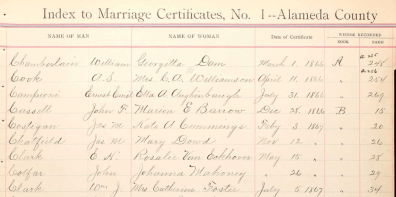 she was called, was my Nana Marge’s mother, i.e. my great-grandmother. Here’s how the record of William and Catherine’s marriage license in Alameda County appears (see last line–and you can click on image to enlarge):
The boy who was born two months after Catherine’s marriage to Clarke was William Dougal Clarke, or “Willie” as he was known. He was always passed off as Clarke’s son. But I have evidence to the contrary in the form of a letter written in 1897 by Lizzie Tenney Clarke to a cousin on her mother’s side back in Illinois. This letter was written one month after her mother’s (Catherine Foster Tenney Clarke) death. The tone of this letter is distressed, and Lizzie voices longing for connection with her mother’s side of the family.
My mother never even told me that Willie was my brother. He always felt nearer and dearer to me, than any of the rest, if I do say it my self…I never can forgive my mother for not telling me things she ought to have told me…
So, it certainly sounds like Willie—who died tragically in a hunting accident at age 23, a young married man with a pregnant wife, Anna Louisa Stover—was not Clarke’s son at all but was likely Willard Tenney’s progeny. From all accounts Clarke appeared to dote on “his” son, in any case.
Catherine Foster was born in Ireland, northern Ireland specifically, and not so far from where Clarke was born and raised.
Unsolved Mystery #1: Did their families have any connection back in Ireland?
By 1848 Catherine had emigrated to the US with her parents and siblings, as a brother was born in Illinois that year (Catherine’s mother was also married twice, once to Edward Little and then to James Foster, and had children with each). The 1850 census finds the family living in Rock Island County, Illinois, where Clarke also lived for 10 years prior to striking out for California. Given the difference in their ages Catherine would have been a child of 7 at the time he left Illinois for California at age 29, but I wonder if their families knew each other? I suspect they must have but I can only speculate at this point. One of Catherine’s half-sisters, Elizabeth Little, married William John Clarke’s brother, Noble Clarke, but so far I don’t have the date or location, only that they eventually lived in Yolo County near William and Catherine.
Unsolved Mystery #2: What, if any, was the connection between the Little/Fosters and the Clarkes in Rock Island County, Illinois?
Catherine’s first marriage occurred in Illinois on September 27, 1861 to Willard Tenney, whose family can be traced back to the Yorkshire district of England from whence they traveled to New England in 1638, to escape “religious persecution”. (They were apparently much aggrieved that King Charles had ordered that “no hindrance should be thrown in the way of those who wished to dance or shoot at the butts [a target] on Sunday afternoons.” Hmm.) By the 1800’s some of the Tenneys had ended up in Illinois via New Hampshire and earlier, Rowley, Massachusetts. Records indicate that Catherine and Willard and their infant daughter Lizzie came to California via wagon train in 1864. I hope to eventually discover which route they traveled and where they first settled. The next piece of information I have is documentation of Catherine’s marriage to Clarke in 1867. What happened during those three missing years? How did Catherine Foster Tenney and Clarke meet? Inquiring minds want to know.
Unsolved Mystery #3: What happened to Willard E. Tenney?
He just seems to disappear from all records. It seems clear from some of Lizzie’s letters to her cousin Eddie in Illinois that her mother was not widowed, but had left her father, whom she says she never remembers seeing (i.e. she was too young at the time of the divorce to retain any memory of him).
Do you ever hear of any of my fathers people. Don’t you know, I just get to thinking of him. Sometimes knowing how terrible he felt, when mama left him for another. I don’t see how she could do it, for she told me he was just as good and kind to her as he could be. The other one [William John Clarke], was not, but it best not to talk of the past, when it is so unpleasant. But you have no idea how I feel when I think of poor old father. I never knew whether he died or was killed or what became of him. My how I would like to have had him with me in his old days.
Lizzie never knew what happened to her father, nor do we. I find this very puzzling in light of all the records that are available to us now. He does not show up in census information, no death certificate, nothing on Find A Grave (a wonderful website for finding where people are buried). I haven’t given up, however. Still searching.
Our story ends today with William John Clarke and his bride, Catherine (Foster) Tenney Clarke settled on their ranch in Yolo County where they proceed to produce five more children in addition to Lizzie and Willie.


 thehollyberryblog